
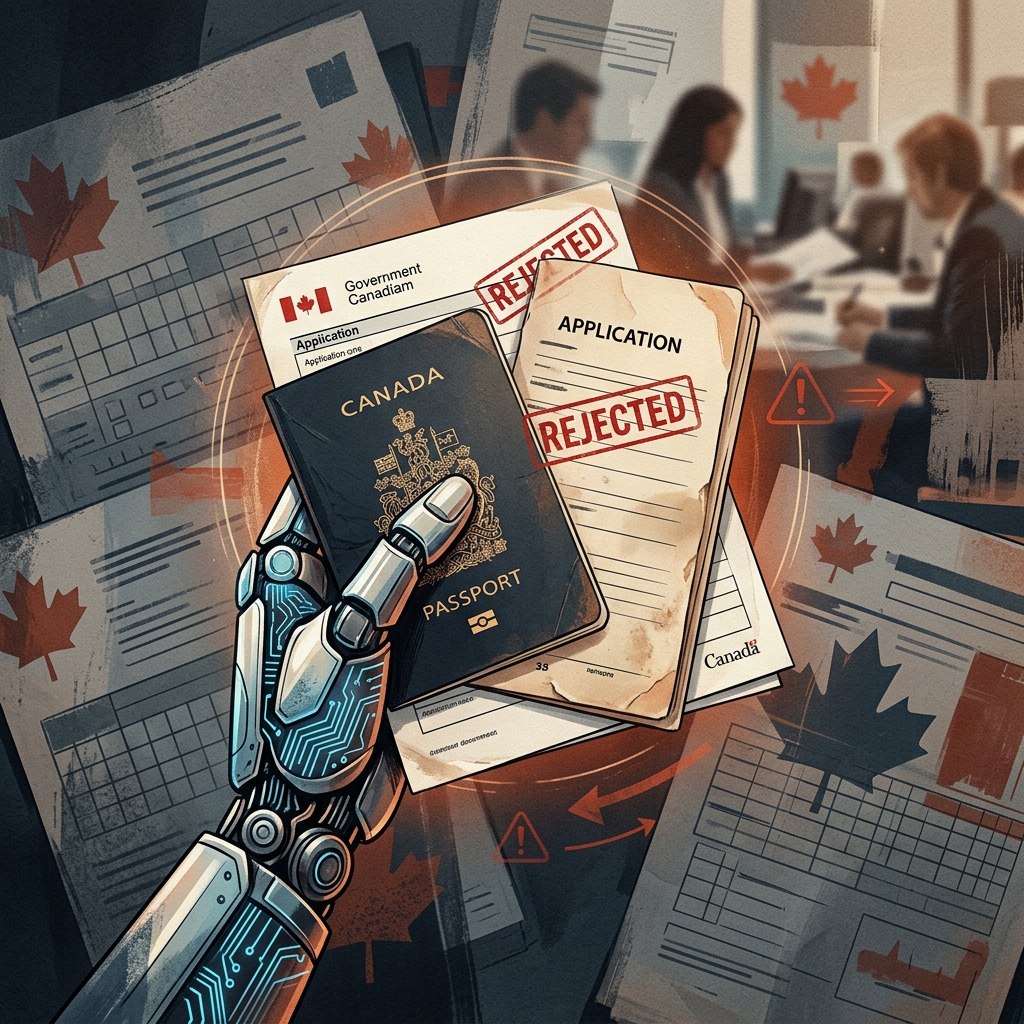
You typed your work history into a chatbot and asked whether you qualify. It came back in seconds — organised, specific, encouraging. It named a stream. It listed requirements. For the first time in months, the path looked clear.
Here is what it did not say: that on June 26, 2026, Ontario closed all eight of its employer job offer streams overnight. That the federal Start-Up Visa is gone. That British Columbia shut its Tech Pathway. That you now get one post-graduation work permit in your lifetime, and going back to school does not reset it.
The tool did not lie to you. It described Canada as it existed the last time it looked — and Canada has been rebuilding this system faster than almost any other area of law.
That is the first risk. The second one is worse, and it does not end with a wasted year. It ends with a five-year ban.
A chatbot cannot be found inadmissible to Canada. You can.
Section 1: It Is Describing a Canada That No Longer Exists
An AI tool that admits it does not know is harmless. One that describes the eligibility criteria of a stream that shut three months ago — in confident, specific, plausible detail — is dangerous, because you will act on it.
| What AI may tell you | What is actually true |
|---|---|
| Ontario's Employer Job Offer and graduate streams are open | All eight closed June 26, 2026, replaced by one Workforce Priority stream |
| The federal Start-Up Visa is your entrepreneur route | Gone. Entrepreneurs now go through the provinces |
| BC has a Tech Pathway and graduate streams | Closed |
| Study again and you get a second PGWP | One per lifetime. A second program does not reset it |
| Six months of experience qualifies you for a category draw | Raised to one year in early 2026 for the category streams |
| You can sponsor your parents this year | The PGP is closed for 2026. The Super Visa is the route |
Illustrative, not exhaustive — and by the time you read this, the list may be longer.
The damage here is rarely a refusal. It is quieter than that. It is the language test booked at the wrong band, the credential assessment you did not need, the twelve months spent assembling a file for a door that was already locked — and the route that was open the whole time, closing while you were busy.
Section 2: Then There Is the Part That Can Ban You
Section 40 of the Immigration and Refugee Protection Act makes you inadmissible to Canada for misrepresenting or withholding a material fact that could induce an error in how immigration law is administered. The standard consequence is a five-year ban.
Three things about that provision, and most people applying alone know none of them:
- Intent is not required. An honest mistake can support the same finding as a deliberate lie.
- An omission counts. Leaving something out is misrepresentation too.
- You cannot pass the blame. In its August 2026 fraud warning, IRCC stressed that applicants remain responsible for everything filed in their name and cannot escape that by saying a representative, interpreter or consultant submitted it.
Read the third one again. If you cannot shift responsibility onto a licensed professional who signed your file, you certainly cannot shift it onto software with no name and no licence. You sign the declaration. You are the only one standing behind it.
Where AI-written documents cross the line
Nobody reading this intends to commit fraud. The problem is that ordinary, well-meaning use produces documents that meet the definition anyway.
- Reference letters. The most common and the most serious. Ask AI to write one and it will optimise — reaching for duties listed under the NOC code you need, whether or not you performed them. Claiming experience you do not have is a false statement about a material fact, no matter who signed the page.
- Explanation letters and study plans. AI fills gaps. Asked to explain a travel history or a year of unemployment, it invents the connective detail that makes the story hang together. You are attesting to that detail.
- Form answers. A general answer about prior refusals or family members is not your specific, complete history — and omissions are misrepresentation.
- "Cleaned up" documents and AI translations. Enhancing a scan alters a document you are submitting as authentic, and IRCC verifies documents with the bodies that issued them. An AI translation with no certified human translator behind it is defective regardless of how good it was.
What a finding actually costs
Refusal. Inadmissibility for at least five years. A record of fraud on your file that you must disclose in future applications and that can count against you after the ban ends. If you are already here: possible loss of permanent resident status, a five-year bar on citizenship, and removal from Canada.
You do not re-apply from this next year. It is the end of the plan for half a decade.
Section 3: Canada's Tribunal Has Already Drawn Its Line
On September 7, 2026, a practice notice signed by IRB Chairperson Manon Brassard came into force across all four divisions of the Immigration and Refugee Board. Parties — including people representing themselves — must not use AI to generate or materially change their own evidence. Basis of claim narratives, affidavits, witness statements. Not rewriting your story, and not altering photographs or screenshots. Spellcheck and formatting are still fine.
Where AI is allowed elsewhere in a filing, it must be declared in the document. Translation and transcription must always be disclosed. If you do not comply, the Board can refuse the document, report counsel to their regulator — or draw a negative inference about whether your evidence is credible at all.
Does this apply to your application?
Only if your matter is before the IRB — a refugee claim or appeal, a sponsorship appeal, a residency obligation appeal, an admissibility hearing or a detention review. It does not govern study permits, visitor visas, work permits or PR applications, which go to IRCC. Plenty of coverage this week has blurred that. But the reasoning behind it applies everywhere: Canada's tribunal has now formally recorded that AI content cannot be trusted to represent a person's truth.
Section 4: So Where Is the Line?
Between understanding something and producing something
| Reasonable | Do not |
|---|---|
| Asking what TEER, ECA, CLB or PAL means | Asking whether you qualify — and acting on it |
| Translating a document so you can read it | Filing that translation |
| Proofreading writing you did yourself | Having it rewrite your story to sound better |
| Drafting questions to bring to your consultant | Using it instead of one |
And one habit worth more than all of this: whatever AI tells you about a Canadian immigration rule, check it against canada.ca or the provincial program page before you spend a dollar or a month on it. Those pages are current. Your tool is not.
The Sawubona Canada View: The People Most at Risk Are the Ones Trying Hardest
We are aware of how this could read — a licensed profession telling you to stop using free tools and start paying for advice. That is not the argument.
The people most likely to hand a file to AI are the ones who cannot afford a consultant, who are writing in a second or third language, and who are afraid of looking unprofessional in front of an officer. They are not cutting corners. They are doing their best with what they have. And they are exactly the people who can least survive a five-year ban that came out of a letter they did not write.
One last thing, and it is the part most people get backwards. Officers are not looking for polish. They are looking for a specific, uneven, concrete account of a real life — the details nothing would think to invent. The smoothed-out version of your story is a weaker document than the awkward one you wrote yourself, before anyone even asks who wrote it.
How Sawubona Canada Helps
Our RCIC-licensed team does the two things AI structurally cannot: assess you against the rules as they stand today, and stand behind what goes in under your name.
- A real eligibility assessment — against current programs and current closures. Start with our free assessment or run your score on the CRS calculator.
- Documents built from your facts — reference and explanation letters developed with you, describing what you actually did, which is what survives verification.
- A review before you submit. If AI touched anything in your file, that needs checking now. A correction made before IRCC finds an error sits very differently than one made after.
We don't guess your path. We build it — and we put our licence behind it.
Sawubona. We see you.
A correction before you submit costs you an afternoon. A misrepresentation finding costs you five years. Have a licensed consultant look at your file while fixing it is still an option.
Book Your Free Consultation +1 647-558-9000 | info@sawubonacanada.com | Free eligibility assessment
Vishal Kapoor, RCIC · Founder & Principal Consultant · RCIC #R707177
Reviewed by RCIC Licensed Consultant Content reviewed for accuracy and IRCC compliance by Sawubona Canada Immigration Inc. (RCIC #R707177). Immigration rules change frequently — book a consultation for advice specific to your situation.
Sources and references: Immigration and Refugee Board of Canada, Practice notice: Use of artificial intelligence in IRB proceedings, signed July 10, 2026, in force September 7, 2026 (Section 6, Effective date). Immigration and Refugee Protection Act, section 40. Immigration, Refugees and Citizenship Canada, public warning on document fraud and misrepresentation, August 2026, including the statement that applicants remain responsible for information submitted on their behalf. Program closures as covered in our own reporting on the OINP, BC PNP and MPNP changes of 2026. Current as of September 8, 2026.
Disclaimer: This article is for general information and does not constitute legal advice. It summarizes a practice notice governing proceedings before the Immigration and Refugee Board of Canada and general principles of inadmissibility for misrepresentation under the Immigration and Refugee Protection Act. Rules change frequently. Decisions on applications are made solely by IRCC, and decisions in Board proceedings solely by the IRB. No outcome can be promised. For advice on your situation, please book a consultation with our RCIC-licensed team.

Reviewed by RCIC Licensed Consultant
Content reviewed for accuracy and IRCC compliance by Sawubona Canada Immigration Inc. (RCIC #R707177). Immigration policies change frequently — book a consultation for advice specific to your situation.
Related Immigration Services

Licensed RCIC, Serving Global Entrepreneurs
Verify Status: RCIC No. R707177
I am a CICC-licensed Regulated Canadian Immigration Consultant based in Mississauga, Ontario. My team has helped business owners from 75+ countries navigate C11, ICT, BC PNP, Alberta AAIP, and Manitoba MPNP. We speak your language, understand your business culture, and build applications that IRCC approves. No ghost consultants, no false promises.
Disclaimer: The information on this page is intended as a general guide and does not constitute legal advice. Immigration laws and policies change frequently. Final decisions on all immigration applications are made solely by Immigration, Refugees and Citizenship Canada (IRCC) and other Canadian immigration authorities. No outcome can be promised. For advice specific to your situation, please book a consultation with our RCIC-licensed team.