
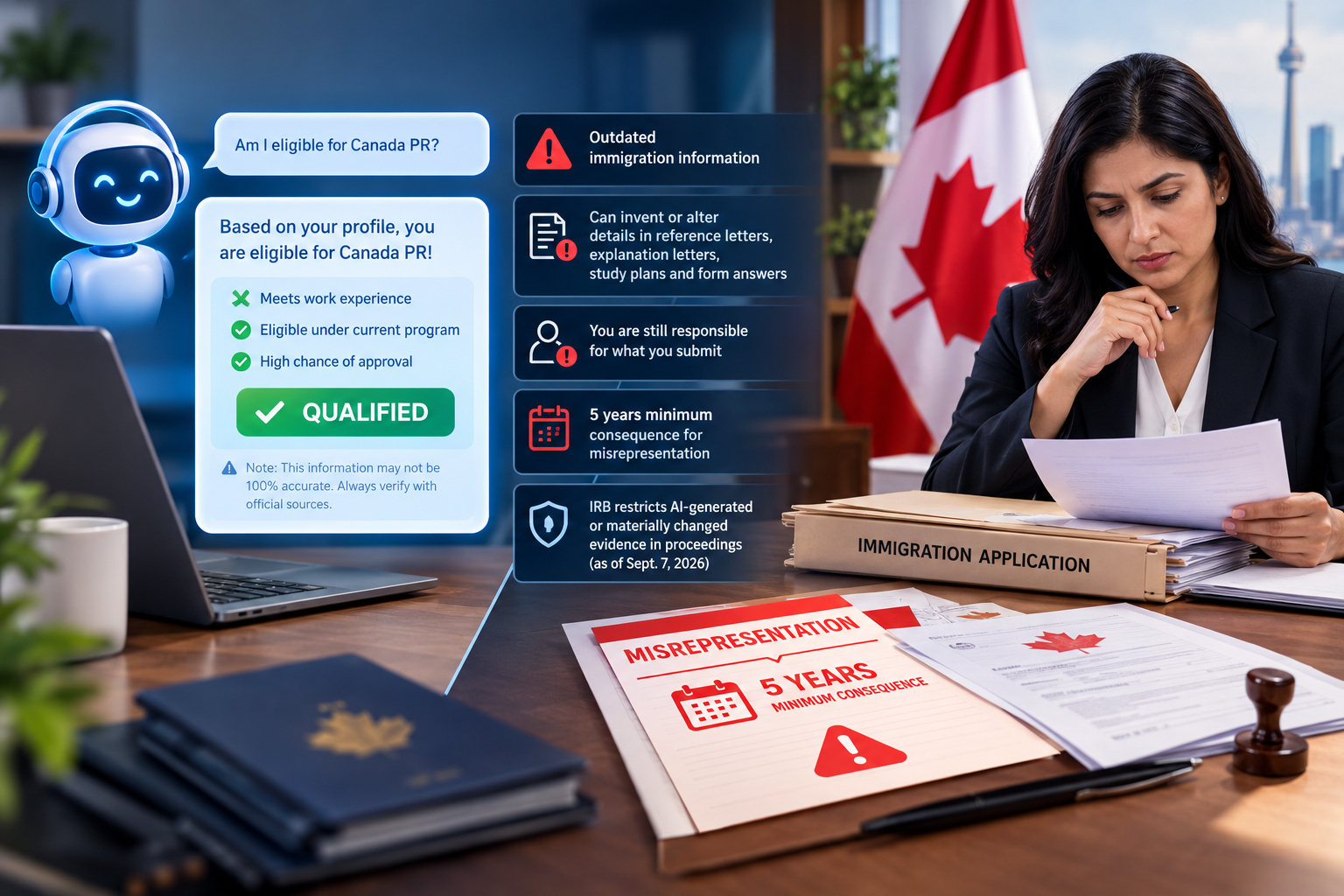
Priya has a sponsorship appeal at the Immigration Appeal Division in six weeks. Her husband's application was refused, she is representing herself because a lawyer quoted her more than she has, and last month she sat at her kitchen table and asked an AI chatbot to turn her messy notes into a clean witness statement. It came back polished. Better than anything she could have written. She was relieved.
Daniyal filed a refugee claim in the spring. His supporting documents — a police report, two letters, a medical record — were all in Urdu. He ran them through an AI translation tool because certified human translation was going to cost several hundred dollars he did not have, and the output looked accurate to him.
Neither of them did anything they thought was wrong. Both of them now have a problem, because as of September 7, 2026, the Immigration and Refugee Board of Canada has rules about exactly this — and one of the possible consequences is the Board drawing a negative inference about whether their evidence is credible at all.
If you are self-representing before the IRB in 2026, you are almost certainly using AI somewhere in your file. This article explains where that is fine, where it is now prohibited, and where it simply has to be declared.
The Board is not worried that AI writes badly. It is worried that AI writes convincingly about things that never happened.
Section 1: What Changed, and When
A practice notice signed in July, effective in September
On July 10, 2026, IRB Chairperson Manon Brassard signed a practice notice governing the use of artificial intelligence in proceedings before the Board. It came into effect on September 7, 2026, and it applies to all four of the IRB's divisions.
The Board's stated reasoning is narrow and practical. AI tools can produce information that is false, fabricated or simply inaccurate, and the notice exists to protect the integrity of the Board's own processes. It is not a philosophical objection to the technology. It is a concern about evidence.
Critically, the notice defines "parties" to include not just lawyers and consultants but self-represented individuals. If you are handling your own appeal or claim, these rules are yours, not just your representative's. And the definition of AI it uses is broad — it covers generative tools that produce text, images, code or other content from a prompt, which is to say it covers essentially every chatbot and image tool a person is likely to reach for.
Read this part carefully
These are rules for proceedings before the IRB, which is Canada's independent immigration and refugee tribunal. They are not blanket rules governing every Canadian immigration application. A study permit application, a visitor visa, a PR application at IRCC — none of those are IRB proceedings, and this notice does not directly govern them. A great deal of coverage this week has blurred that line and frightened people who are not affected. If your matter is an application to IRCC rather than a hearing or appeal at the Board, keep reading anyway for the practical warning at the end, but do not panic about a rule that does not apply to you.
Section 2: The Hard Prohibition: Your Own Story
This is the rule that matters most, and it has no disclosure workaround
The most consequential provision in the notice is a flat prohibition, not a disclosure requirement. Parties must not use AI to generate or materially change content that reports or reflects a person's own evidence. The Board names three examples specifically: basis of claim narratives, affidavits, and witness statements. Its position is that these must come from the person's own knowledge and experience.
The notice sets out prohibited uses plainly. You may not use an AI tool to draft a basis of claim narrative, an affidavit or a witness statement. You may not use one to rewrite a person's story. And you may not use one to create or alter photographs, videos, screenshots or other corroborative evidence.
That last item deserves emphasis, because people rarely think of it as falling under the same heading. Running a photograph through an AI enhancer, cleaning up a screenshot, sharpening a scanned document — these touch corroborative evidence, and the Board has put them in the prohibited column.
What is still allowed
The prohibition does not extend to minor assistive functions. Spellcheck, grammar correction and formatting assistance remain fine, provided those tools do not generate the evidence or make material changes to it. In other words: fixing your typos is not the problem. Handing your story to a machine and publishing what it hands back is the problem.
The practical line to hold is this one. Write it yourself, in your own words, however imperfect. Then tidy the spelling. Do not reverse that order.
Section 3: Where AI Is Allowed but Must Be Declared
Submissions, research, transcription and translation
Outside of personal evidence, the notice takes a disclosure approach rather than a prohibition. If a party uses AI to generate or materially change content in a document submitted to the Board, a written declaration must be included in that document.
The declaration has to state that AI was used to create or materially change text in the document, and that all AI-generated content — along with the authenticity of any case law or other legal authorities cited — has been reviewed and verified by a named person. The IRB publishes the exact wording it expects, and you should copy that current text directly from the Board's practice notice rather than paraphrasing it. Parties may optionally add detail about which software was used, for what purpose, and whether AI touched the whole document or only certain paragraphs.
Translation and transcription: always disclose
This is where Daniyal's file runs into trouble, and it is the provision most likely to catch ordinary self-represented claimants. Use of AI for transcription or translation must always be disclosed. There is no threshold and no exception.
On top of that, the rules across all four divisions already require translated documents to be accompanied by a declaration from a human translator — and that translator must now declare whenever AI was used to assist in the translation. An AI translation with no human translator behind it does not satisfy the Rules, and it did not before September 7 either. What is new is the explicit obligation to disclose the AI's involvement.
Verification is on you, not the tool
The notice is direct about responsibility. Parties are always accountable for what they put before the Board, and anyone using AI to build a case must ensure the output is accurate, verifiable and trustworthy. That includes systematically checking legal principles and case citations against reliable sources — legal databases, official government websites, established commercial publishers, or trusted public services such as CanLII.
And there is a trap inside that instruction worth flagging: the Board specifies that AI-generated summaries or AI tools found within those otherwise reliable sources do not count as verification. Using a database's own AI summary to confirm a case says what an AI told you it says is not verification. You have to read the decision.
Two further expectations in the notice
Be ready to answer for it. Parties should always be prepared to answer questions about their use of AI in a proceeding, and when asked, must be able to establish that their documents are authentic and accurate.
Do not pad. The Board tells parties not to fill submissions with AI-generated material that has nothing to do with the facts of their case, citing the Federal Court on the point, and states flatly that longer submissions are not better submissions. Volume has never persuaded a decision-maker. It now actively signals AI use.
And a caution on privacy. The notice reminds parties that some AI tools lack the security features needed to keep sensitive information confidential. Pasting your medical history, your children's details or a police report into a free chatbot is a disclosure of that information to a third party.
Section 4: What Happens If You Get It Wrong
Five consequences, and the second one is the dangerous one
Where a party does not follow the practice notice, the Board sets out what it may do:
- Refuse to accept the document for filing, or otherwise decline to rely on it.
- Draw negative inferences about the credibility of the evidence.
- Disclose information to counsel's professional regulatory authority, under the Board's existing policy on reporting the conduct of authorized representatives.
- Restrict or prohibit counsel from appearing before the IRB.
- Take any other necessary action.
The first consequence is recoverable. A document refused for filing can often be fixed and refiled. The second one frequently is not.
In a refugee claim or a sponsorship appeal, credibility is not one factor among many — it is very often the whole case. A decision-maker who concludes that your written narrative was machine-generated is entitled to wonder what else in your account was constructed rather than lived. That doubt attaches to you, not to the document, and it follows you into the hearing room. You cannot un-ring it by explaining that you only wanted the grammar to look professional.
The third and fourth consequences point at representatives, and they matter when you are choosing one. A consultant or lawyer who is casual about this is risking their own ability to appear before the Board — and your case along with it.
Section 5: Whose Cases Are Covered?
All four divisions, which is a wider net than most people assume
The notice applies across the entire Board. If your matter is in front of any of these divisions, it applies to you.
| Division | What it decides |
|---|---|
| Refugee Protection Division | Refugee protection claims made in Canada |
| Refugee Appeal Division | Appeals of refugee protection decisions |
| Immigration Division | Admissibility hearings and detention reviews |
| Immigration Appeal Division | Sponsorship appeals, residency obligation appeals, removal order appeals |
Read that last row again if you are a permanent resident or a sponsor, because it is the row most people skip. Refused a spousal or partner sponsorship and appealing it? Facing a residency obligation appeal because you spent too long outside Canada? Those are IRB proceedings. The witness statement you were planning to have a chatbot polish is squarely inside these rules.
Section 6: The Mistakes We Are Already Seeing
Four patterns, all of them well-intentioned
1. Letting AI write the story "just to make it sound better" This is the most common and the most damaging. People are not trying to fabricate anything — they are embarrassed about their written English and want to be taken seriously. The instinct is understandable and the outcome is a prohibited document. If language is the barrier, the answer is an interpreter and a representative, not a chatbot.
2. AI-translating foreign-language documents Certified translation is expensive and the temptation is obvious. But translated documents require a declaration from a human translator, and AI involvement must be disclosed. An AI-translated police report with no translator behind it is a defective document regardless of how good the translation actually was.
3. Citing cases the AI invented Fabricated citations have already embarrassed represented parties in Canadian proceedings. If a case name, a paragraph number or a legal proposition came from an AI tool, it has to be verified against the actual decision in a reliable source before it goes anywhere near a submission.
4. Assuming these rules cover every immigration application The mirror-image mistake. This notice governs IRB proceedings. It does not follow that AI is safe or advisable everywhere else — an explanation letter or statement of purpose that reads as machine-written can still damage an IRCC application, and misrepresentation rules apply to applications regardless of who or what drafted them. But the specific prohibitions and declarations set out here belong to the Board.
The Sawubona Canada View: This Rule Protects You More Than It Restricts You
It is easy to read a notice like this as one more obstacle placed in front of people who are already struggling. We read it differently.
The people most likely to hand their life story to an AI tool are the people who cannot afford representation, who are writing in a second or third language, and who are terrified of looking unprofessional in front of a decision-maker. Those are precisely the people whose credibility is most fragile and who can least afford to have it questioned. A rule that stops a well-meaning person from filing a machine-written narrative six weeks before their hearing is, on balance, protective — provided they find out about it in time.
Which is the actual risk here. The notice took effect on September 7, 2026. Files being prepared right now, by people with no lawyer and no idea this happened, are being built with tools that are no longer permitted for the most important document in the case. Nobody is going to send them a letter about it. They will find out at the hearing.
There is also a version of this that is simply good practice and always was. A decision-maker does not want your story to be elegant. They want it to be yours — specific, uneven, full of the small concrete details that no language model would think to invent. That is what reads as true, because it is.
How Sawubona Canada Helps
If you have a matter before the IRB, or a refusal you are thinking about appealing, our RCIC-licensed team works on the parts of the file this notice touches directly:
- Drafting from your facts, properly. We take your account through structured interviews and build the narrative and statements from what you actually tell us — which is both what the Board requires and what holds up under questioning.
- Document and translation compliance. Making sure foreign-language documents come with the human translator declaration the Rules require, with any AI assistance disclosed as the notice now demands.
- Reviewing files already in progress. If AI has touched a document in a matter you are preparing, that needs assessing now rather than at the hearing. We can tell you what has to be rebuilt.
- Appeals and refusals. Sponsorship appeals, residency obligation appeals, and refused applications where the reasons given were thin — including where a refusal lacked real explanation.
We don't guess your path. We build it — from first assessment through to hearing.
Sawubona. We see you.
If AI has touched any document in a matter you have before the Board, the time to deal with it is before the hearing, not during it. Have an RCIC-licensed consultant review your file while there is still room to fix it.
Book Your Free Consultation +1 647-558-9000 | info@sawubonacanada.com | Free eligibility assessment
Vishal Kapoor, RCIC · Founder & Principal Consultant · RCIC #R707177
Reviewed by RCIC Licensed Consultant Content reviewed for accuracy and IRCC compliance by Sawubona Canada Immigration Inc. (RCIC #R707177). Tribunal procedure and immigration policy change frequently — book a consultation for advice specific to your situation.
Sources and references: Immigration and Refugee Board of Canada, Practice notice: Use of artificial intelligence in IRB proceedings, signed July 10, 2026 by Chairperson Manon Brassard, in force September 7, 2026. IRB, Policy on Disclosing Information Regarding the Conduct of Authorized Representatives to Regulatory Bodies. Federal Court, Messa c. Canada (Citoyenneté et Immigration), 2025 CF 1557, cited in the practice notice on submission length (French only; no official English translation available at the time the notice was written). All details current as of September 8, 2026.
Disclaimer: This article is for general information purposes and does not constitute legal advice. It summarizes a practice notice governing proceedings before the Immigration and Refugee Board of Canada and is not a substitute for reading the notice itself or obtaining advice on your own matter. Tribunal procedures and immigration rules change frequently. Decisions on immigration applications are made solely by Immigration, Refugees and Citizenship Canada (IRCC), and decisions in Board proceedings are made solely by the IRB. No outcome can be promised. For advice specific to your situation, please book a consultation with our RCIC-licensed team.

Reviewed by RCIC Licensed Consultant
Content reviewed for accuracy and IRCC compliance by Sawubona Canada Immigration Inc. (RCIC #R707177). Immigration policies change frequently — book a consultation for advice specific to your situation.
Related Immigration Services

Licensed RCIC, Serving Global Entrepreneurs
Verify Status: RCIC No. R707177
I am a CICC-licensed Regulated Canadian Immigration Consultant based in Mississauga, Ontario. My team has helped business owners from 75+ countries navigate C11, ICT, BC PNP, Alberta AAIP, and Manitoba MPNP. We speak your language, understand your business culture, and build applications that IRCC approves. No ghost consultants, no false promises.
Disclaimer: The information on this page is intended as a general guide and does not constitute legal advice. Immigration laws and policies change frequently. Final decisions on all immigration applications are made solely by Immigration, Refugees and Citizenship Canada (IRCC) and other Canadian immigration authorities. No outcome can be promised. For advice specific to your situation, please book a consultation with our RCIC-licensed team.